On September 7, 1861, Marie Pauline Martin entered into the world with beautiful brown hair and brown eyes in her parent’s home on rue du Pont-Neuf in Alençon, France. At the birth, of each child, Azélie would pray: “Lord, If ever it would be lost, I prefer that you should take it without delay.” (ML) Little Pauline resembled her mother both in personality and in looks. She became the second-born child of nine children of Louis and Azélie Martin. Louis and Azélie honored each of their children with the first name of Marie in honor of Our Lady and honored each male child with the additional name of Joseph in honor of St. Joseph. The children’s second name was given after their godparents. Pauline’s godfather was her uncle Isidore Guérin and her godmother was Pauline Romet, a close family friend in Alençon. The blessed day arrived on September 8, 1861 when Pauline was carried in her mother’s arms to the Cathedral of Saint Pierre-de-Montsort and baptized by Father Lebouc. Each morning Pauline's mother would make it a habit to rise early to attend morning Mass. Before participating in Mass she would light a candle and pray reverently before the statue of Our Lady. Humble at heart, Azélie petitioned Our Lady for the children that she and her husband were given by God, that one day they would become saints. She would also ask Our Lady for her children to be more reverence toward God then she was. Sadly, four of the Martin children would never make it to adulthood. Azélie gave birth to her fourth child on October 13, 1864, Marie Hélène who passed away on February 22, 1870, at the age of five. Louis and Azélie were given the blessing of receiving another child on September 20, 1866 with the birth of their first son, Joseph Louis Martin. It was with great sadness the he too past away a year later on February 14, 1867. On December 19, 1867 the birth of their second son, Joseph Jean Baptiste was born and Pauline, in particular, was very excited at his birth. Her parents, Louis and Azélie gave Pauline the honor of being this child’s godmother. However, he too was taken away from them on August 25, 1868. The life of Louis and Azélie’s sixth daughter, Marie Mélanie Thérèse was very short from August 16, 1870 to October 8, 1870. Pauline, like her mother, developed a high level of energy to accomplish many things in such a short span of time. As a very young child, Pauline exhibited the same healthy characteristics as her older sister Marie. However, Pauline developed a bad case of whooping cough. But with many prayers from her family at her side, Pauline’s whooping cough soon disappeared. From the start, Pauline was very affectionate towards her family encompassing a soft, angelic voice. Out of pure instinct, she would consistently give her family several kisses, even blowing a kiss to a statue of Jesus and Our Lady. Louis and Azélie took special interest in the development of each one of their children’s lives. At the earliest stages of Pauline’s life, both parents would correct her when she did something wrong. They never allowed Pauline, even at the earliest stages of her life, to go without being corrected. Up to the age of two, Pauline's mother worked with Pauline on her frequent bouts of stubbornness and was able to conquer them. Their mother would teach both Marie and Pauline how to pray to God. Every morning and every night, Azélie would kneel beside Marie and Pauline, at their bedside, and all of them would pray their prayers to God. Both Marie and Pauline would continually reverse their prayers to their parents to show each one of them no special preference over the other. Before Marie and Pauline went to bed, their parents would read to them the lives of the saints. They were promoting, instilling and fostering in them the spirit of faith showing them that the things the world offered to them was simply vain. Occasionally, Azélie would take Marie and Pauline to the Cathedral to pray prayers before the Blessed Sacrament. Before they would leave, Pauline would rush upstairs to go to her room and quickly put on her most beautiful dress. Upon returning to her mother she would ask her to clean her face. Louis and Azélie always stressed the importance to them that they should, “Obey through love, always try to please the dear Jesus, and most importantly to make small sacrifices for Him.” (ML) One small example of Pauline making sacrifices was when her sisters would want to use something of hers. Pauline's mother would be at her side and tell her to give it up to them so that she could earn another pearl in her crown, affectionately, Pauline would obey. Pauline’s education first started at home; however, it was time for her to start receiving a formal education. Her mother started preparations for both Marie and Pauline to attend the Visitation boarding school in Le Mans. Sister Marie Dosithée, Azélie’s sister, was instrumental in getting Marie and Pauline admitted into the boarding school. Through the years, the boarding school became a very popular place among the elite, in France, for sending their children. It was the perfect place for the Martin children to go there because Sister Marie-Dosithée was there to keep a close eye on them. In October of 1868, Louis, Azélie, Marie and Pauline boarded a train to Le Mans. Previously, they had taken Marie and Pauline on short trips to see their relatives in Lisieux and also their aunt in Le Mans. However, this time they would leave them behind to start their education. The separation as a family turned out to be very difficult for both the children as well as the parents. Also, the loss of Pauline's grandfather took place the same year. Pauline's mother constantly wrote numerous letters to encourage both Marie and Pauline to do well in their schoolwork as well as maintaining a high level of piety. On July 19, 1870, The Franco-Prussian War began. France declared war on Prussia and the lower German states then aligned themselves with the North German Federation. The French military would soon realize that the German army was far more superior in combat than their French adversaries. As each battle ensued, French towns in the northern part of France started to fall, leaving behind massive amounts of wounded and dead. Once the Germans had advanced onto Le Mans in the latter part of December of 1870, parents from all over the area rushed to retrieve their children from the Visitation boarding school; Louis and Azélie were no exception. Pauline's mother sought out several options to retrieve their children but the only option was for them to travel the lengthy road to Le Mans. It was impossible to go by train because the French army was using it for the war effort. Louis set off along the dangerous roads by carriage to Le Mans to retrieve his daughters. Louis safely brought his daughters back home amongst seeing for themselves the spoils of war. Sadly, Le Mans fell on January 11, 1871. The Germans in turn used the boarding school to house the wounded, which in some cases, the wounded soldiers transmitted deadly communicable diseases to the local townspeople. After the fall of Le Mans, the city of Alençon would be no exception. It too fell. As the German army advanced onto Alençon, Azélie led all of the children into the root cellar as the bombs started to land nearby. Once the smoke cleared and the town officially surrendered, the Germans then forced each French family to house a number of German soldiers. The Martin family housed nine German soldiers on the bottom floor of their house during their occupation, which then lasted until May 10, 1871. Soon after the war ended, things started to get back to normal for the Martin family. They inherited the home once owned by Azélie’s father, Isidore Sr. The home was much larger then what they had. So, they made the decision to leave their home on rue du Pont-Neuf and move into their new home on rue Saint-Blaise. On January 2, 1873, Marie and Pauline were home for the holidays and their mother gave birth to their newly born sister. The next day, they were given the opportunity to glance their eyes upon their new little sister, Thérèse. A few months later, Marie contracted typhoid and she was sent home from the Visitation boarding school. As a result of Marie’s illness, Pauline was forced to stay at the boarding school during her Easter break. Emotionally, it was a very difficult time for Pauline to be away from her family because Marie and Thérèse were both fighting to stay alive. Weeks after Easter, Marie recovered from her illness and Thérèse was sent to live with a wet nurse. Pauline arrived in Alençon by train on Whit Sunday. She described the event of seeing her home after the long train ride: “My heart almost stopped beating when I caught sight of my own home; I thought I would collapse with emotion and I had to stop for a minute to avoid fainting.” (SF) She was overjoyed by the fact that she was able to see her sister Marie as well as going to visit her other sister Thérèse. For once the entire family would be together again for just a short time. After returning to the Visitation boarding school, Pauline continued to strive to be the best in all of her studies. Eventually, she would surpass most of her fellow peers of her own age group. Pauline understood from the start, at what cost it was for her parents to place both her, Marie and Léonie in school. So, she used her graceful talents to the best of her ability, earning her many awards. Her teachers looked upon her as a very talented, very gracious and thoughtful student. To Pauline's mother, piety was the most important virtue above all others that she thought all of her children should have. It was her antidote for Pauline’s successes in her studies to keep her heart humbled. Pauline’s aunt became her "surrogate mother" and reprimanded her when she fell out of line. Pauline’s biggest obstacle for herself was to control her temper. She became very sensitive when other students harassed or attacked her. Azélie also saw how tender Pauline’s heart was and continued to encourage her, through letters, to overcome her obstacles. Their mother stated in one of her letters to both Pauline and Marie: “You must serve the good God faithfully, my dear girls, and beg to be, one day, in the number of those saints whose feasts we as a family celebrate.” (ML) Pauline studied her catechism feverishly, preparing herself for her First Holy Communion. She wanted to make every effort meaningful when it was time to consecrate herself to God. On July 2, 1874, dressed in her beautiful white gown and veil, Pauline walked down the aisle to receive her First Holy Communion. Her family surrounded her at the Visitation Chapel in Le Mans as she consecrated herself to God. Her mother still pursued the prospects of her becoming more pious. She remarked to Pauline in a letter: “You are a good little girl, very affectionate, very submissive, but not yet pious enough.” (ML) Pauline’s aunt, Sister Marie Dosithée, reaffirms to Azélie and tells her that Pauline will be pious. Pauline’s mother reinforces her love for her by saying: “You are my true friend. You give me courage to endure life with patience. Be always the joy to others that you have been to me. The good God will bless you not only in the next world, but in this, because he is always happiest even in this life, who always bravely does his duty.” (CWe) Another of Azélie’s main focuses for Marie, Pauline, and Léonie is that they become holy. Pauline's mother states in a letter addressed to Marie: “I want all of you to become saints.” Pauline's mother also focused her energy on Pauline maintaining her virginity. When Pauline was much younger, her mother would place her on her knees and tell her: “Only virgins would follow the spotless Lamb, Jesus, and that they would be crowned with white roses while singing a song that others could not sing.” (SF) Pauline reaffirmed to her mother that she would refrain from marriage and always stays a virgin for Jesus. Religious life was Louis and Azélie’s desire for each of their children that they would be consecrated to God. Pauline was the first of their children to exhibit any interest in becoming a nun. Her aspiration was to become a Visitation nun like her aunt. Pauline's mother, seeing her daughter’s aspirations to enter the religious life, started to cultivate slowly into her soul the desire to pursue it. Azélie writes in a letter on July 9, 1876: “In spite of my desires to give them all to God, if He was to ask these two sacrifices (Marie and Pauline), I should do my best even though I would suffer as a result of giving them up.” (SF) It was known throughout the family that Pauline would become a nun. As for Thérèse, from the age of two, did not know what a nun was but wanted to follow Pauline’s example. She, too, wanted to become a nun. Reflecting back on her childhood, Thérèse states to Pauline about entering the religious life: “It was by your example, which drew me to the Spouse of Virgins.” (SS) Family life in the Martin household was filled with much excitement in all its simplicity. They would come together around the piano and sing religious songs. The girls would show their competitive skills in a game of draughts (checkers). But after having fun playing all of their games, Marie and Pauline would then bring out a book such as Dom Gueranger’s Liturgical Year, which was given to Pauline as a present by her father. They would read it to the rest of the family before they retired for the night and say their evening prayers. When it came time to celebrate a Saint’s Feast Day, the family would have a little celebration of their own to honor them. For example, on St. Catherine’s feast day, cake was Pauline’s favorite food to celebrate this event. Pauline developed a love for painting, using the attic as her studio; she painted several watercolors, which her father had framed. He placed a couple of them in the Pavilion. One of her paintings at the Pavilion was of a fish that Louis once caught. When Louis went on trips, he would bring her back some shells, ivory or parchment so that she could paint little miniatures on them. She also spent time learning to sew and do needlework. When the family spent time at the Pavilion, during the summer months, Marie, Pauline, and Léonie were each given a small plot of land to cultivate and plant a garden. The girls successfully grew several types of vegetables and flowers. They especially loved to pick strawberries. While there they would rest under a tree next to the water and have a picnic. Soon, October of 1876, came and things would change for the worst. It was Pauline’s last year as a student at the Visitation boarding school. By December, it was widely known that her aunt, Sister Marie-Dosithée, whom contracted tuberculosis, was very sick. It was a very heart wrenching experience for Pauline to see her “surrogate mother” suffer so much from this deadly disease. In addition, Pauline was to find out that her mother was suffering from breast cancer. In January of 1877, Azélie went to see her sister for the last time, as well as, to comfort Pauline. Pauline's mother says to her: “Have courage, my dear Pauline, whatever the good Lord sends us, we should submit to it. If I lose my dear sister, I shall not weep for her, but for myself. She will be happy; it is we who will have sorrow. But this sorrow will be soothed by the certainty of her happiness.” (ML) On February 24, 1877, Pauline’s holy aunt, Sister Marie Dosithée, took her last breath. The Martin family arrived by train to Le Mans to pay their last loving respects. All of the children wore black dresses out of respect for their aunt’s death. Her funeral was conducted in the Visitation Chapel and her body was then laid to rest nearby. By the time summer arrived in 1877, the state of Azélie’s health worsened and had reached to the reality that only a cure from God was her only avenue of staying alive. Previously, she had sought out doctors to cure her of her cancer, but all of them told her it was too late for a cure. She decided that she would make a pilgrimage to Lourdes. Pauline was so convinced that by going to Lourdes that this was the miracle they were seeking. But her mother cautioned Pauline by saying: “We must prepare ourselves to be ready to accept generously the will of God, whatever that may be.” (ML) There was only one group from the city of Angers, at the time, making plans to leave on June 18th to go on a pilgrimage to Lourdes. Azélie, Marie, and Léonie traveled by train a few days earlier from Alençon to Le Mans to pick up Pauline and then proceed onto Angers. They left Angers on June 18th with the other pilgrims by train to Lourdes. On the train from the city of Angers to Lourdes, a calamity of misfortunes occurred. The first occurrence happened when a pot of coffee tipped over onto their luggage as well as onto their food. The coffee seeped into the luggage and stained their clothes. The food that they brought with them met the same fate and had to be thrown out. As soon as the train arrived in Lourdes, it was Pauline's mother expectation to go to the Lourdes baths immediately. But first they needed to drop off their luggage at the hotel. Unaware of the state of the hotel, when they placed their reservations, it became apparent, when they arrived, that it was not suitable for the four Martin women. So, they were forced to leave and seek refuge elsewhere. Each day, they would endure a new misfortune, from the loss of their aunt’s rosary to their mother spraining her neck. These events were chipping away at any expectation that their pilgrimage was going to be a fruitful one. As Pauline and her sisters watched their mother, day after day, being dunked in the icy cold waters of Lourdes’, it became apparent that there was not going to be a cure for their mother’s cancer. With deep regret, they boarded the train for home, on June 22nd, without a cure in hand. They first traveled to Le Mans to drop off Pauline at the Visitation boarding school and then traveled onto Alençon. Pauline became very distraught over the realization that her “best friend” was going to die. As soon as Pauline's mother arrived home, she immediately changed her focus from her expecting to be cured to preparing herself for her impending death. Immediately, Azélie wrote a letter to her daughter Pauline to ease her grief over her approaching death. Her mother wrote: “Are you still angry with our Blessed Mother because she did not make you dance with joy? … Do not look for much joy on earth, for if you do, you will be disappointed. As for me, I know by experience to what extent to rely on the joys of the earth. If I did not live only, for the joys of Heaven, I would indeed be very miserable.” (CWe) On August 1, 1877, Pauline completed her studies at the Visitation boarding school. The celebration and the awards she received were somewhat bittersweet. She was leaving behind the beloved memories of her “surrogate mother” who passed away just months prior. It was also hard to say farewell to her childhood friends and to head home to help her mother die. Once Pauline arrived back home she assisted Marie in preparing Léonie, Céline and Thérèse in their studies. It was of great concern for Pauline's mother to have all of her children properly educated. She tasked this responsibility onto Marie and Pauline. Realizing that their mother would never see the rest of her daughters complete their education, Marie and Pauline put on an awards ceremony for her. It was their way for their mother to celebrate with them on the future completion of their schooling. After sending Céline and Thérèse to a neighbor’s house for the day, Pauline spent time at her mother’s bedside attempting to ease her pain. Her mother looks at her after she kissed her hand and replies with a loving look: “Poor little soul! What a vacation for you! And I who was rejoicing to have you back home for good. Oh, my Pauline, you are my treasure. I know well that you will one day become a nun.” (SF) As the end of August approached, the physical pain from Azélie’s cancer spread throughout her body. The pain became unbearable for her to move even an inch without crying out to God. As Pauline sat beside her mother, she grabbed and kissed Pauline’s hand and then pointed to her sisters. Azélie signaled to Pauline that she was relinquishing all of her responsibility as a mother over to her. As night approached on the 28th of August, Pauline escorted her two little sisters, Céline and Thérèse, to their room to go to bed. Azélie’s painful departure from this world would soon follow around midnight. Just after her mother’s soul ascended to Heaven, Pauline’s uncle Isidore went outside at the back of the house and called out to Pauline at her bedroom window. Answering her uncle’s call, he told her in a low voice that her mother just died. Pauline decided not to wake her little sisters up and waited until the morning to tell them. On August 29, 1877, the family escorted their mother’s body to the Cathedral and then onto the Cimetière Notre Dame (Our Lady’s cemetery) in Alençon. The family’s maid saw them and gave them her sympathies for their mother’s suffering. She said to them: “You poor little girls, you have no mother.” (SF) Thérèse then leaped into Pauline’s arms and said to Pauline that she will be her mother. Days after their mother’s death, Céline approached Pauline and asked her if their mother gave her any sign that her soul made it to Heaven. Pauline said to Céline that she received a dream of an angel writing in the sand: “Blessed are those that mourn, for they shall be comforted.” (ML) This was a confirmation to Pauline that their mother’s soul ascended to Heaven. Before Azélie’s death, she suggested to Louis, that he should consider moving to Lisieux to be closer to her family. So, Louis and the children focused their eyes on Lisieux so that they would be closer to their cousins. Pauline’s father discussed it with her and Marie about making the move to Lisieux. He conceded to both of his daughter’s desires for a new change in scenery. After a long search, their uncle found them a place live. The family would nickname their new home: “Les Buissonnets”. It was emotionally difficult for each of them to leave behind their dear friends and neighbors. There were many memories spent in their home that they will leave behind. One of which was the untimely death of their beloved mother. On November 14, 1877, the family said their goodbyes at their mother’s grave before leaving to Alençon. Lisieux was a small city with roughly 16,000 residents. It had the same pleasantness as any small city, which was the perfect place for the Martin children to grow up. The famous Cathédrale Saint-Pierre de Lisieux (Cathedral of St. Peter’s of Lisieux) was in the center of town as well as many small shops and government buildings. “Les Buissonnets” was located on a hill side on the outer edge of the city. Their new home encompassed a large backyard with plenty of trees and hedges. But unfortunately their home lacked many modern amenities such as indoor plumbing and electricity. Family life resumed after they set up their new home. Every morning, Louis, Marie and Pauline would attend morning Mass at the Cathedral. Pauline, as well as her sisters, joined a religious organization called the Children of Mary which promoted the adoration of the Blessed Sacrament. Each week, Pauline devoted two days praying before the blessed sacrament as part of the requirements for the religious organization. Pauline continued painting her miniatures and portraits which were admired by her family for its fine detail. Pauline also was very good in sewing. She took upon herself to make an alb for Father Ducellier, whom was her spiritual director at that time. She embroidered it with fine guipure lace. After receiving his newly crafted alb, Father Ducellier went to the Martin home to thank Pauline personally for the beautiful gift. At times, Pauline had to keep a close eye on her father when he read certain religious books. Louis would be enlightened by a book that he read which inspired him to practice some form of mortification. Some of these mortifications were too stringent on his delicate health and Pauline would have to intervene and strategically remove the book from his possession. In the evenings, Pauline would place Thérèse on her knees and take out a religious book and read it to her. After reading the book, there would be a multitude of questions that Thérèse would ask her. In one particular instance, Thérèse was concerned that each person’s good deeds, whether they were large or small, would not share the grace of God’s glory equally. Pauline asked her to bring out her father’s drinking glass and also a thimble. Pauline filled both of them up and asked Thérèse to compare each of them to see which one was fuller. Thérèse responded back that both of the containers were equally full. Pauline stressed to her the point that each person regardless of their stature in society will receive the same grace of God’s glory equally. There is no reason to be envious of another human being regardless of what they have done or how much they have done for the grace of God’s glory. Preparations for Thérèse’s formal education were a priority for Pauline before she entered the Benedictine school in Lisieux. Pauline not only taught Thérèse lessons in such studies as grammar, catechism but also lessons in piety. Pauline conditioned her to the rigors of school life before she entered by having her do lessons and then grading her on them. Thérèse was rewarded by Pauline for her successes but also reprimanded her for her faults. Years later, Thérèse remarked: “I have asked myself many times how you were able to bring me up with so much love and tenderness and without spoiling me. You never allowed any of my imperfections to escape, and every reproach of yours was truly deserved.” (SST) Thérèse was reaching the age of her first confession. To prepare her for it, Pauline had her examine her conscious on a daily basis for her to see whether or not she committed any sins. Pauline asked her to confess her sins to the priest as if she were speaking to God. Later, Thérèse remarked to Pauline on her first confession: “You said to me that confessing my sins to a priest was not to the priest himself but to God. I asked, should I also tell him that I loved him too as if he were God in the flesh and you agreed.” Pauline worked with Thérèse on studying the catechism for her First Holy Communion. Later, Marie took over teaching Thérèse after Pauline entered the Carmelite monastery. Generosity was always the spirit of faith in the Martin family home. Les Buissonnets would be no exception. The poor would congregate outside the family’s home every Monday to receive some form of charitable gift. Pauline would have Thérèse meet them at the front entrance to find out from them what their needs were. Thérèse, in turn, would come back to Pauline and tell her. Pauline would decide on what to distribute to them whether it was food, clothing, or money for the people in need. Even if the person was not able to come to their home, they would make the effort to go to their homes and help them. It was a great lesson for Thérèse given by Pauline to overcome some of the fears she had. During times of leisure the girls would go sit by the river either sketching the local scenery or working on their needlework while their father went fishing. Pauline would prepare a basket of food for their little adventures. After spending five years at Les Buissonnets, it was time for Pauline to answer the call to the religious life. Her eyes were focused on the Visitation convent in Le Mans. She frequently went on visits to her former boarding school and spoke with the Mother Superior about entering the convent. But God had other plans for her to serve Him. On February 16, 1882, while praying beside a statue of Our Lady of Mt. Carmel at St. Jacques Church (St. James’s Church), Pauline received a revelation that she is to become a Carmelite nun. Acting on this revelation, Pauline made frequent visits to the Carmelite monastery in Lisieux to speak to the prioress about entering into their Order. But at the time that she was seeking to enter, there was not any room at the monastery. So, she looked into entering the Carmelite monastery in Caen. And as soon as she was going to make her final decision to join them, a postulant at the Carmelite monastery in Lisieux died suddenly which left an opening for Pauline to enter. Written by: R. Hann Bibliography Abbé Combes, ed. Collected Letters Of Saint Thérèse of Lisieux . (CL) New York: Sheed & Ward, 1949. Dolan, Albert H. Rev.. Collected Little Flower Works. Chicago: Carmelite Press, 1929. (CW) ---. Life of the Little Flower (CWa) ---. Living Sisters of the Little Flower (CWb) ---. Our Sister is in Heaven (CWc) ---. Where the Little Flower seems nearest (CWd) ---. The Little Flower’s Mother. Chicago: Carmelite Press, 1929. (CWe) ---. An Hour with the Little Flower (CWf) ---. God Made The Violet Too: Life of Léonie, Sister of St. Thérèse. (GV) Chicago: Carmelite Press, 1948. Piat, Stéphanie Fr. The Story Of A Family: The Home of St. Thérèse of Lisieux. (SF) Trans: Benedictine of Stanbrook Abbey. Rockford, Ill.: Tan Books and Publishers, Inc., 1948. Baudouin-Croix, Marie. Léonie Martin : A Difficult Life. (LM) Dublin : Veritas Publications, 1993. Beevers, John, trans. The Autobiography of St. Thérèse of Lisieux: Story of a Soul. (SS) New York: Doubleday, 1957. Clarke, John, trans. St.Thérèse of Lisieux: Her Last Conversations. (LC) Washington, D.C.: ICS Publications, 1977. Martin, Celine. My Sister St.Thérèse Trans: The Carmelite Sisters of New York. (MST) Rockford, Ill.: Tan Books and Publishers, Inc., 1959. Martin, Celine. The Mother of the Little Flower Trans: Fr. Michael Collins, S.M.A. (ML) Rockford, Ill.: Tan Books and Publishers, Inc. 1957 Mother Agnes of Jesus. Marie, Sister of St. Thérèse. Ed. Rev. Albert H. Dolan, O.Carm. Chicago: Carmelite Press, 1943. (M) Piat, Stéphanie Fr. The Story Of A Family: The Home of St. Thérèse of Lisieux. (SF) Trans: Benedictine of Stanbrook Abbey. Rockford, Ill.: Tan Books and Publishers, Inc., 1948. ---. CÉLINE: Sister Geneviève of the Holy Face. Trans: The Carmelite Sisters of the Eucharist of Colchester, Conn. San Francisco: Ignatius Press, 1997. © Redmond, Paulinus Rev. Louis and Zélie Martin: The Seed and The Root of the Little Flower London: Quiller Press Limited, 1995. (SR) Rohrbach, Peter-Thomas, O.C.D. The Search for St. Therese (SST) Garden City, New York: Hanover House, 1961 Martin, Pauline. Little Counsels of Mother Agnes of Jesus, O.C.D. (LCM) Lisieux, France, Office Central de Lisieux- distributed by Carmelite Monastery of Ada, Michigan Helmuth Nils Loose, Pierre Descouvemont. Thérèse and Lisieux (TOL) Trans: Salvatore Sciurba, O.C.D. and Louise Pambrun, Grand Rapids, Michigan Wm. B. Eerdmans Publishing Co., 1996 Gibbons, James Cardinal. Holy Bible (Douay-Rheims) 1899 Edition. (B) Baronius Press Unlimited, London, United Kingdom, 2005 |


Holy Cards
Prayers
Booklets

| For information on receiving a copy of the booklet: "Little Counsels of Mother Agnes of Jesus, O.C.D" Please click on the booklet |
Devotion
Prayer Petition
Directory
 |
 |
 |
 |
 |
 |
 |
 |
 |
 |
 |
 |
 |
 |
 |
 |
 |
 |
| Sub Directory |


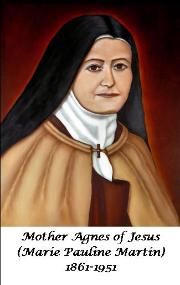
| Mother Agnes of Jesus Marie Pauline Martin "The Pearl of Lisieux" |

Copyright © 2005-21 by r hann All Rights Reserved
Start of StatCounter Code -->

Martin Sisters
Multimedia
Connections
Communications
 |
 |
 |
 |
 |
| Sub Directory |
| Page I |

| "Jesus is asking us to be saints. He needs completely devoted souls that are totally surrendered to His divine pleasure." - Mother Agnes of Jesus |
| Mother Agnes of Jesus |

| © Carmel of Lisieux and Office Central of Lisieux |
| "The Pearl of Lisieux" |

| Eric Gaba (Wikimedia Commons user: Sting) |
Born:
Country:
Providence:
County:
City:
Died:
Country:
Providence:
County:
City:
Venerated at:
First Holy
Communion:
Entrance
into the monastery:
Patronage:
Country:
Providence:
County:
City:
Died:
Country:
Providence:
County:
City:
Venerated at:
First Holy
Communion:
Entrance
into the monastery:
Patronage:
September 7, 1861
France
Lower Normandy
Orne
Alençon
July 28, 1951
France
Lower Normandy
Calvados
Lisieux
Carmelite Monastery
in Lisieux
July 2, 1874
The Visitation Chapel at
the Visitation monastery
in Le Mans
October 2, 1882
Carmelite Monastery in
Lisieux
Acute Myeloid Leukemia
Beta-Mannosidosis
Bone Cancer
Chronic Myeloid
Leukemia
Cystic Fibrosis
Farber Disease
Gaucher Disease
Hunter's Syndrome
Lung Cancer
Maroteaux-Lamy
Syndrome (MPS)
Morquio A Disease
(PPMPS 1 VA)
Multiple Sclerosis (MD)
Pompe Disease
Reflex Sympathetic
Dystrophy Syndrome
(RSDS)
Schizophrenia
Seborrheic Dermatitis
France
Lower Normandy
Orne
Alençon
July 28, 1951
France
Lower Normandy
Calvados
Lisieux
Carmelite Monastery
in Lisieux
July 2, 1874
The Visitation Chapel at
the Visitation monastery
in Le Mans
October 2, 1882
Carmelite Monastery in
Lisieux
Acute Myeloid Leukemia
Beta-Mannosidosis
Bone Cancer
Chronic Myeloid
Leukemia
Cystic Fibrosis
Farber Disease
Gaucher Disease
Hunter's Syndrome
Lung Cancer
Maroteaux-Lamy
Syndrome (MPS)
Morquio A Disease
(PPMPS 1 VA)
Multiple Sclerosis (MD)
Pompe Disease
Reflex Sympathetic
Dystrophy Syndrome
(RSDS)
Schizophrenia
Seborrheic Dermatitis
| Download Centre |
Booklets

| For information on receiving a copy of the booklet: "Mother Agnes of Jesus" Please send us your request in the Holy Cards Section and place in the comments section "Mother Agnes of Jesus booklet" to receive a free copy |

FAST TRAC


| Receive yours today! >> |
| Add yours Today! >> |
| In Need of a Prayer? >> |
Websites